Back to Journal
Studio
It started with a Minecraft server.
Ivelin Markov started Markov Solutions in 2022. The first “startup” came in 2014: a Minecraft server, funded with lunch money and gone two days after launch.
5 November 2026
5 min read

Studio
Ivelin Markov started Markov Solutions in 2022. The first “startup” came in 2014: a Minecraft server, funded with lunch money and gone two days after launch.
5 November 2026
5 min read
Listen to this entry
0:00 / 5:51
It’s 2014. I’m a sixth grader in Montana (the town in north-west Bulgaria, not the American state), and I spend most of my time playing video games instead of studying for school. Mainly a small game called Minecraft. You might’ve heard of it: that September, Microsoft agreed to pay $2.5 billion for the company that makes it.
Who could’ve guessed that this little gaming hobby would turn into my very first “startup”: a scrappy Minecraft project where I built a team, found funding and launched a product (sort of)?
Start a public Minecraft server, make it “the best out there”, sell in-game perks for real money and become filthy rich. It wasn’t the most original idea. I just wanted to recreate what the servers I played on were already doing.
But how could a thirteen-year-old possibly build and launch a successful Minecraft server? Well, I had access to Google. After a few weeks of endless trial and error I finally had something: a simple server that other people could join. It didn’t do much yet, but it was a start, and naturally the next step was to assemble a team.
I pitched the idea to a few friends who played with me. They built the in-game structures while I kept experimenting with how servers actually worked, and soon I’d learned to read and modify plugins, the pieces of open-source code that make a server more than the game out of the box. Slowly, our little project started taking shape. We were proud of what we’d built, and it actually looked like something worth playing.
There was just one problem. My old, cheap PC could barely keep the server alive with three players online. If we wanted to grow we needed proper hosting and, more importantly, we needed players who would pay for in-game perks. That’s when I realised we needed a website.
Looking at the competing servers, I noticed that all their URLs ended in .php. So, naturally, I googled “How to build a website using PHP”. That was it: my first step into web development, at thirteen, completely self-taught.
A few weeks later I had my first working website for our server. I started marketing it too: I built a Facebook page, posted screenshots and promoted what we’d made. To launch the server, we pooled our “funding”: $5 each, out of our lunch money.
On launch day we hit 60 concurrent players. Success, right? Well… not quite. Someone found an unprotected part of the world and destroyed it. I didn’t have a backup (why would I?), and two days later the server was gone.
At the time we didn’t think of it as a business. We were just having fun. Looking back, though, it was my first attempt at entrepreneurship, and one part of it is still standing: the server’s Facebook page remains the most successful social media profile I’ve ever had, with more than 5,000 followers.
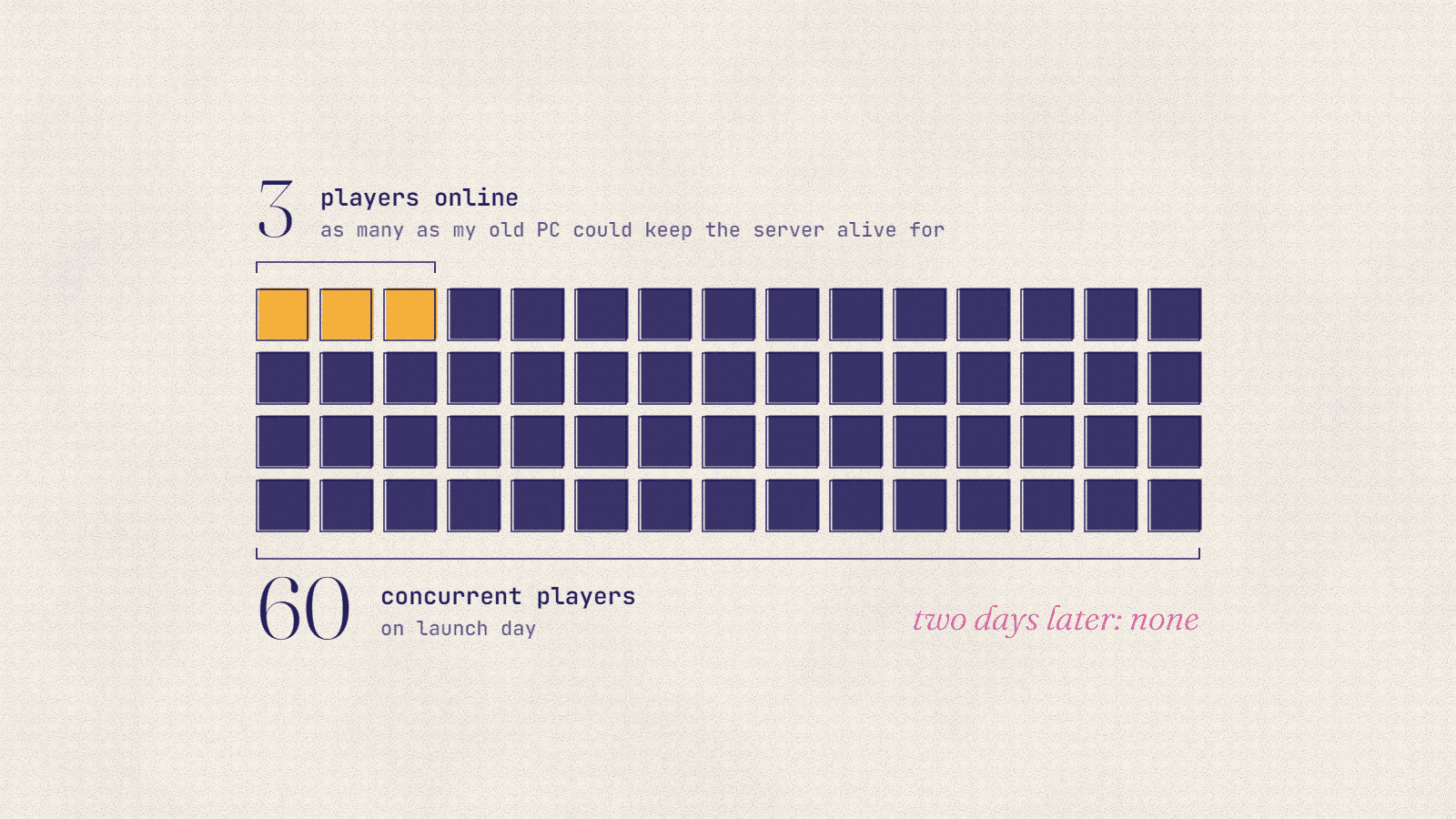
Sixty players on launch day. Two days later, no server.
A year later the idea resurfaced, and this time I planned everything carefully. I wanted a professional website, with accounts, a forum and chat: the full package. I dived deeper into PHP and built it, very ugly but functional, logins and all. The server itself never happened, but by then I was officially hooked on web development.
My next “big idea” was a note-taking website, with the tagline: “Aren’t you tired of thinking about something and then forgetting it? Well, not anymore. Welcome to…” I’ll spare you the name.
Cringe? Maybe. But I did it. I built a complete web app, with accounts, notes you could create, edit and delete, and even an admin panel where I could read everyone’s notes (don’t worry: there were exactly zero users). It was my first fully functional web application.

In ninth grade I enrolled in a three-year, government-funded course in software engineering and practical programming. It ran on weekends and through the school breaks.
A year in, a guest lecturer from a web development company told us: “We’re working with young talents like you. If you’re interested in a real job, give me a call.” At first I was sceptical. But when I heard that a classmate had got an interview, I decided to go for it. I called the guy, and at sixteen I was accepted as an intern.
Suddenly I was working on real projects for real clients. Three years later I had worked my way up to team lead, managing a team of five developers.
That’s when it hit me. I love building products, and I love leading teams, so why not start my own agency? In 2022 I quit the job and did exactly that. And that, dear reader, is how Markov Solutions was born.
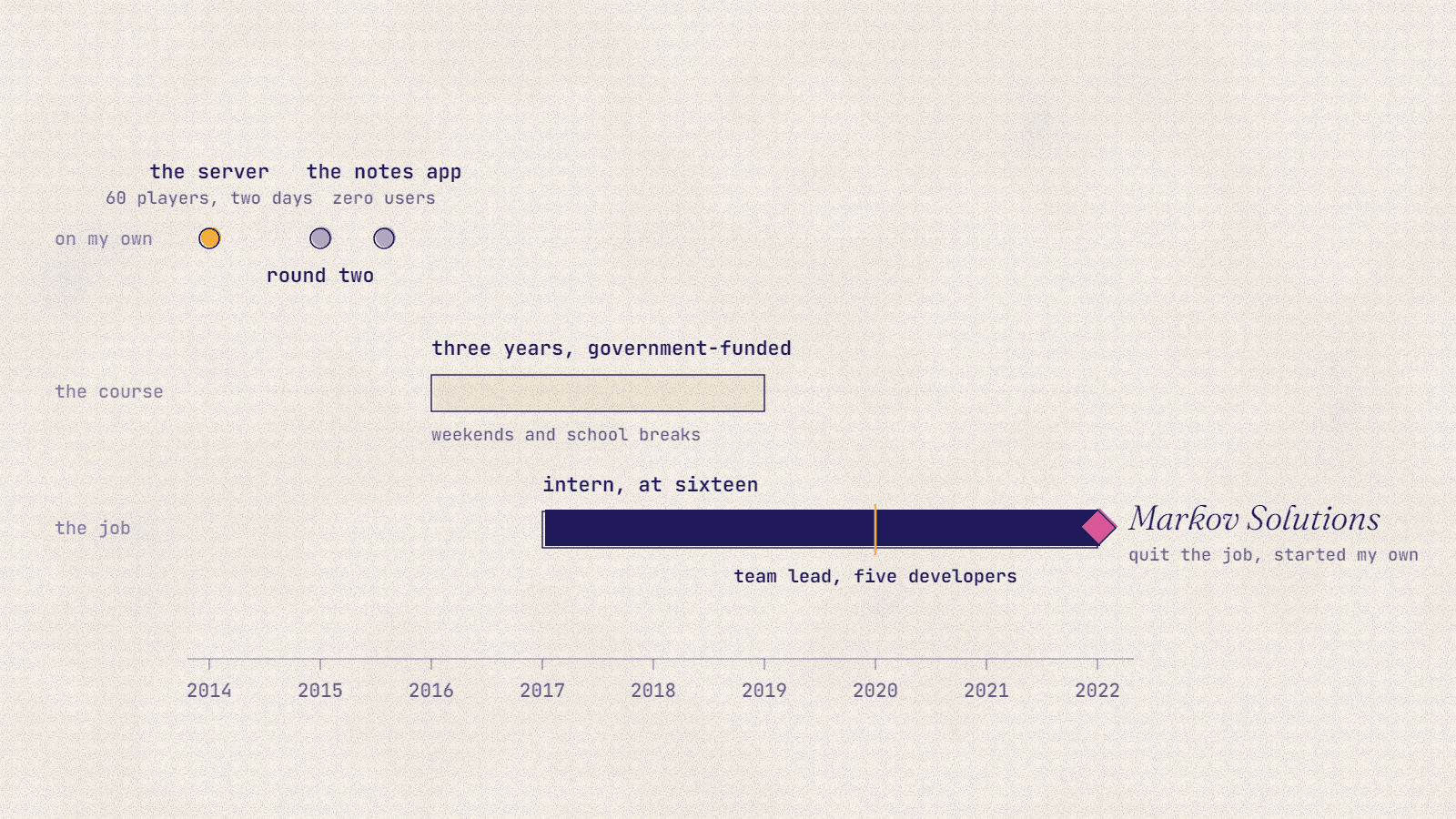
The server never came back, and the notes app never did get a user. Markov Solutions is registered in Montana, the town where all of this started, and works from an office in Sofia: a small team of senior engineers, building for clients now rather than for players. If you have something you’d like built, send us a brief.
— End of article 03
Studio
¶ — Continue reading
Studio · 11 min
Outsourcing gets argued as a cost question, which is the least interesting thing about it. The real trade is who holds the knowledge when the engagement ends — so here is how we would decide, including the cases where you should not hire us.
Engineering · 9 min
Bulgaria adopted the euro on 1 January 2026. Re-denominating a live shop is a small piece of arithmetic wrapped in a large piece of care — here is where the money hides, and how we move all of it at once.
¶ — Newsletter
Get an email when we publish something new from the studio. No spam.